Alien and Invasive Tree Removal in Gauteng
Alien and invasive tree removal is the work of clearing trees that the law says you must control: syringa, black wattle, several gum species and others on the national list. Tree Felling Guys removes them from gardens, plots, estates and commercial sites across Gauteng, takes the wood away or leaves it cut for firewood, and deals with the stumps so they do not come straight back.
If you own property in South Africa, invasive trees are not only a garden problem. Under the National Environmental Management: Biodiversity Act, landowners have a legal duty to control listed invasive species, and when you sell, you must tell the buyer about them in writing. This page explains what the law asks of you, which trees are on the list in Gauteng, how they are removed properly, and what it costs. We have done this for ten years, we are fully insured, and you get a written quote before work starts.
What the Law Requires of Property Owners
The Alien and Invasive Species Regulations, published under the National Environmental Management: Biodiversity Act (NEMBA) and in force since 1 October 2014, sort invasive plants into four categories. What you have to do depends on the category:
| Category | What it means for you |
|---|---|
| 1a | Must be combated and eradicated. These are new or rare invaders, and the state may come onto your property to remove them. |
| 1b | Must be controlled and removed. No planting, propagating, buying or selling. Most of the common garden invaders in Gauteng sit here. |
| 2 | Allowed only with a permit in a specified area, such as a timber plantation. Outside that area, the plant is treated as Category 1b. |
| 3 | May stay where it is, but you may not plant, propagate or sell more. In a riparian area, along a river or wetland, it is treated as Category 1b. |
Two parts of the regulations catch homeowners out.
Selling your property. The seller must notify the buyer in writing that listed invasive species are present on the property. Estate agents increasingly ask for this, and a buyer can use an undisclosed infestation in negotiation. Clearing before you list is simpler than disclosing.
Penalties. The Act allows fines of up to R5 million or up to ten years' imprisonment for non-compliance, rising to R10 million for a repeat offence. Prosecutions of private homeowners are rare, but the duty is real, and municipalities and estates can and do enforce it.
The full species lists are published by the Department of Forestry, Fisheries and the Environment. This page is general information, not legal advice.
Invasive Trees We Remove Most Often in Gauteng
Gauteng sits mostly in the grassland biome, which affects how some species are listed. These are the invaders we clear most often.
- check_circleSyringa (Melia azedarach). Category 1b. The most common invader in older Gauteng gardens, spread by birds eating the berries. It suckers and reseeds freely, and the berries are poisonous to people and pets.
- check_circleBlack wattle and silver wattle (Acacia mearnsii and Acacia dealbata). Category 2, so outside a permitted plantation they must be controlled. They form dense thickets along fences and streams on plots, use large amounts of water, and leave seed in the soil that stays viable for decades.
- check_circleGum trees, including blue gums and red river gums (Eucalyptus species). Red river gum is Category 1b in grassland, riparian and protected areas, which covers much of Gauteng. Other eucalyptus species carry Category 2 listings with conditions. Most of the old blue gum windbreaks on Gauteng plots fall into one of these groups.
- check_circleJacaranda. The City of Tshwane lists it as Category 3: an existing tree may stay, but no new planting. Along a stream or wetland it moves to 1b. Our Pretoria tree felling page covers jacarandas in detail.
- check_circleBugweed, lantana, privet and pyracantha. Smaller trees and shrubs that fill the understorey of neglected gardens and plot corners. Volunteer groups at reserves such as Kloofendal in Roodepoort and Modderfontein in the east spend years clearing exactly these species.
Not sure what you have? Send us a photo. If it is indigenous, it may be protected rather than invasive, and our guide to protected and indigenous trees in South Africa explains the difference. Our arborist can identify anything we cannot from the picture.
How Invasive Trees Are Removed Properly
There are three recognised ways to control invasive plants: mechanical, chemical and biological. Biological control, releasing insects or fungi that attack a specific invader, is run nationally and is not something a homeowner arranges. On a property, the work is mechanical and, where needed, chemical.
- 1Identify and plan. We identify each species, check whether any trees are indigenous or protected, and work out which can be felled whole and which must come down in sections near buildings.
- 2Fell or pull. Large trees are felled or dismantled. Saplings and seedlings are pulled out by the roots, because a pulled sapling cannot resprout.
- 3Deal with the stump. This is where most DIY clearing fails. Syringa, wattle and gum all resprout from a cut stump, often within weeks, and a cut tree can come back as five stems instead of one. We grind each stump below ground with our stump grinder, which removes the growing point and stops most resprouting.
- 4Remove or leave the wood. We take the timber away, or cut it to length and leave it if you want firewood. Wattle and gum burn well. Wood from a tree infested with shot hole borer is chipped on site and never moved, so the beetle does not travel with it.
- 5Follow up. Invasive seed stays in the soil, and some stumps will still try. A follow-up visit three to six months later to pull seedlings and cut any regrowth is what turns a clearing into a permanent result. We can quote the follow-up with the main job.
Why the Hardest Part Is What Comes Back
People ask which plant is hardest to get rid of. In Gauteng, it is usually black wattle, not because the tree is hard to fell but because the soil under an old wattle thicket holds seed that can stay viable for up to 50 years. Every fire or soil disturbance triggers a new flush. Syringa is the other one: birds keep reseeding it from neighbouring gardens, so a cleared syringa garden needs watching.
The only way to get rid of an invader permanently is to remove the tree, stop the stump resprouting, and pull the seedlings until the seed bank runs out. Felling alone, without stump treatment and follow-up, usually makes the problem worse.
Plots, Estates and Commercial Sites
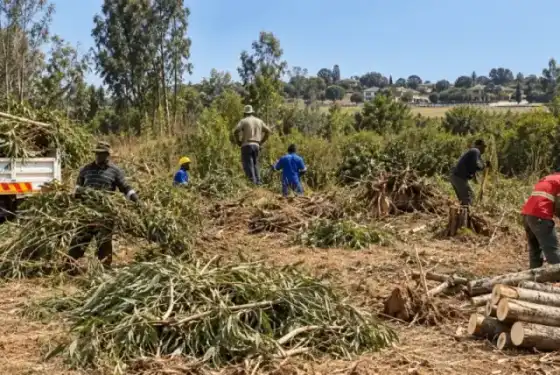
Most large clearing jobs are on smallholdings and estates, where decades of unchecked wattle, gum and syringa have taken over fence lines, stream banks and corners. Open ground means trees can be felled whole, so a big clearing costs far less per tree than a garden job. Our pages on tree felling in Krugersdorp, Roodepoort and Kempton Park cover the plot work in those areas.
For estates and body corporates, invasive control on common property is usually part of the estate's environmental obligations. We can clear once and return on a schedule, through our estate and commercial tree maintenance work. Where a whole plot needs clearing for building, see land clearing.
What Invasive Tree Removal Costs
Single trees are priced like any tree felling job: from around R850 for a small tree with easy access, up to R15,000 or more for a large tree that has to be dismantled over a building. Thickets and plot clearing are priced per job after a site visit, because the number of trees, the density and the access vary so much. Several trees in one visit always cost less per tree than separate visits.
Keeping the wood for firewood lowers the quote. See our tree felling prices page for the full ranges.
Alien and Invasive Tree Removal FAQ
How do you get rid of invasive alien plants?
expand_more
Remove the plant, stop the stump resprouting, and pull new seedlings until the seed in the soil runs out. Felling alone is not enough for syringa, wattle or gum, because all three resprout from the stump. A follow-up visit three to six months later is part of doing it properly.
What are examples of alien invasive trees in Gauteng?
expand_more
Syringa, black and silver wattle, blue gums and other listed eucalyptus, jacaranda (Category 3 in Tshwane), bugweed, lantana, privet and pyracantha are the ones we clear most often.
What is the most invasive tree in South Africa?
expand_more
There is no single official answer, but black wattle is among the most damaging nationally because of how much water it uses and how long its seed survives. In Gauteng gardens, syringa is the invader we remove most.
What are the three methods used to get rid of alien plants?
expand_more
Mechanical control (cutting, felling, pulling), chemical control (herbicide on cut stumps or foliage) and biological control (insects or fungi that attack a specific invader). On a residential property, the work is mostly mechanical.
Do I have to remove invasive trees on my property?
expand_more
For Category 1b species, yes: you must control them. Category 2 species need a permit to keep, and Category 3 species may stay but may not be planted or spread. When you sell, you must tell the buyer in writing about listed invasive species on the property.
Do I need a permit to remove an invasive tree?
expand_more
No. You do not need a permit to remove a listed invasive tree from your own property; the law requires you to control it. You do need the municipality's approval for a tree on the pavement, whatever the species. Our permits and bylaws guide has the detail.
Will a syringa or wattle grow back after it is cut?
expand_more
Usually, yes, if the stump is left. Both resprout strongly from a cut stump. Grinding the stump and a follow-up visit stop it.
Can I keep the wood?
expand_more
Yes, for most species. We cut it to length and leave it, which lowers the quote. The exception is wood from a tree infested with shot hole borer, which is chipped on site and must not be moved.
Get a Free Invasive Tree Removal Quote
Send a few photos of the trees and tell us the suburb or plot. For a single tree, you get a written quote, usually the same day. For a plot or thicket, we come and walk it first, identify every species, and quote the clearing and any follow-up together.
We clear invasive trees everywhere we work in Gauteng. See the full list of areas we serve.